Built From the Ground Up: The Science of Leg & Glute Hypertrophy
Build Stronger Legs. Develop Better Glutes. Train With Purpose.
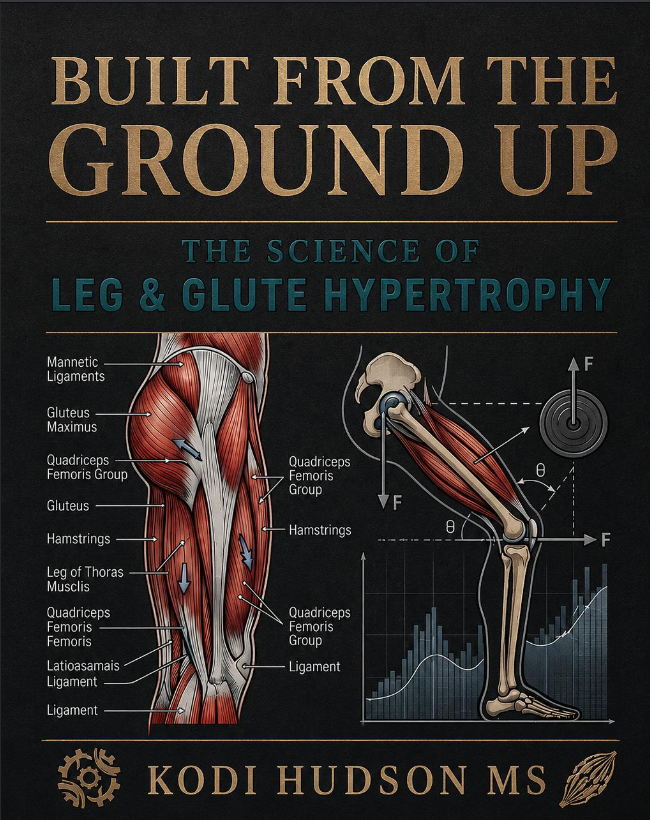
Take a comprehensive, science-based approach to lower body development with Built From the Ground Up: The Science of Leg & Glute Hypertrophy. This complete guide breaks down the anatomy, biomechanics, training science, exercise selection, and programming strategies behind building stronger, more muscular, and aesthetically balanced legs and glutes. It is designed to simplify complex concepts into practical knowledge that can be immediately applied in the gym.
What You’ll Learn Inside:
• Science-Based Muscle Growth: Learn how mechanical tension, progressive overload, training volume, recovery, and stretch-mediated hypertrophy drive lower body development.
• Complete Lower Body Anatomy: Understand how the glutes, quadriceps, hamstrings, adductors, calves, pelvis, hips, knees, and ankles work together to produce movement and muscle growth.
• Exercise Execution & Technique: Master the setup, biomechanics, execution, common mistakes, coaching cues, and progression for the most effective lower body exercises.
• Program Design: Learn how to structure training splits, choose the right exercises, manage volume and frequency, progress over time, and build programs for every experience level.
• Recovery & Injury Prevention: Discover how to optimize recovery, prevent common lower body injuries, troubleshoot plateaus, and continue progressing long-term.
Topics Covered:
• Lower body anatomy and biomechanics
• Glute maximus, glute medius, and glute minimus development
• Quadriceps, hamstrings, adductors, calves, and tibialis training
• Exercise encyclopedia with detailed technique breakdowns
• Squats, RDLs, hip thrusts, lunges, split squats, hack squats, leg presses, leg extensions, leg curls, kickbacks, hip abductions, adductions, and calf training
• Program design, training splits, progression models, and specialization phases
• Beginner through advanced training programs
• Intensity techniques and advanced programming methods
• Nutrition essentials for muscle growth
• Recovery, troubleshooting, injury prevention, and case studies
• Training templates, glossary, and evidence-based references
Perfect For:
• Beginners learning proper lower body training fundamentals
• Bodybuilders and physique competitors
• Personal trainers and strength coaches
• Powerlifters and athletes looking to improve performance
• Anyone wanting to maximize leg and glute growth through evidence-based training
Table of Contents
PART I THE SCIENCE OF LOWER BODY GROWTH……………………………. 8
Chapter 1: Why the Lower Body Is the Foundation…………………………………………. 9
Chapter 2: The Evolution and Purpose of the Glutes………………………………………. 11
Chapter 3: Genetics Versus Training…………………………………………………………… 13
Chapter 4: Myths, Misinformation, and the Feeling Trap………………………………… 15
PART II COMPLETE LOWER BODY ANATOMY………………………………… 18
Chapter 5: The Skeletal Foundation: Bones, Joints, and the Pelvis……………………. 19
Chapter 6: The Gluteal Group……………………………………………………………………. 21
Chapter 7: The Deep Hip Rotators………………………………………………………………. 24
Chapter 8: The Quadriceps………………………………………………………………………… 26
Chapter 9: The Hamstrings………………………………………………………………………… 28
Chapter 10: The Adductors………………………………………………………………………… 30
Chapter 11: The Calves and Lower Leg……………………………………………………….. 32
Chapter 12: Connective Tissue, Fascia, and the Neuromuscular System…………….. 34
PART III THE SCIENCE OF MUSCLE GROWTH………………………………… 36
Chapter 13: The Mechanisms of Hypertrophy……………………………………………….. 37
Chapter 14: Stretch Mediated Hypertrophy and Lengthened Partials…………………. 40
Chapter 15: Progressive Overload and Volume Landmarks……………………………… 42
Chapter 16: Frequency, Intensity, and Proximity to Failure……………………………… 44
Chapter 17: Fibers, Motor Units, and Neural Adaptation…………………………………. 46
Chapter 18: Recovery, Adaptation, and Sex Differences…………………………………. 48
PART IV GLUTE AESTHETICS AND REGIONAL BIAS………………………. 51
Chapter 19: Regional Development of the Glutes………………………………………….. 52
Chapter 20: Aesthetics, Illusion, and the Silhouette……………………………………….. 54
PART V BIOMECHANICS OF THE LOWER BODY……………………………… 56
Chapter 21: Hip Mechanics: The Engine Room…………………………………………….. 57
Chapter 22: Knee and Ankle Mechanics………………………………………………………. 59
Chapter 23: Pelvis, Spine, Bracing, and Breathing…………………………………………. 61
Chapter 24: Resistance Profiles: Why the Tool Changes the Stimulus……………….. 63
PART VI THE EXERCISE ENCYCLOPEDIA………………………………………… 65
Chapter 25: The Exercise Encyclopedia: How to Read It………………………………… 66
Chapter 26: Hip Dominant Movements: Thrusts and Bridges…………………………… 68
Chapter 27: Hip Dominant Movements: Hinges…………………………………………….. 75
Chapter 28: The Deadlift Family: Conventional, Sumo, and Trap Bar……………….. 81
Chapter 29: The Squat Pattern: Free Weight Variations………………………………….. 85
Chapter 30: The Squat Pattern: Machine Variations……………………………………….. 91
Chapter 31: Lunges, Split Squats, and Step Ups…………………………………………….. 97
Chapter 32: Isolation: Quadriceps and Hamstrings……………………………………….. 104
Chapter 33: Abduction, Adduction, and Kickbacks………………………………………. 110
Chapter 34: The Lower Leg: Calves and Tibialis…………………………………………. 119
PART VII PROGRAM DESIGN……………………………………………………………. 124
Chapter 35: Leg Training Fundamentals: Where Beginners Start……………………. 125
Chapter 36: The Principles of Program Design……………………………………………. 128
Chapter 37: Exercise Selection and Sequencing…………………………………………… 130
Chapter 38: Sets, Reps, and Volume Allocation…………………………………………… 132
Chapter 39: The Training Week: Splits and Frequency…………………………………. 134
Chapter 40: Periodization and Progression Models………………………………………. 136
Chapter 41: Deloads, Autoregulation, and Building Your Program…………………. 138
PART VIII THE PROGRAM VAULT……………………………………………………. 140
Chapter 42: How to Use the Program Vault………………………………………………… 141
Chapter 43: Foundational Programs: Beginner to Early Intermediate………………. 142
Chapter 44: Glute Specialization Programs…………………………………………………. 145
Chapter 45: Quad and Hamstring Focused Programs……………………………………. 148
Chapter 46: Balanced Intermediate Hypertrophy Programs……………………………. 150
Chapter 47: Home, Minimal Equipment, and Time Efficient Programs……………. 152
Chapter 48: Athletic, Women Focused, and Contest Programs……………………….. 154
PART IX ADVANCED TRAINING METHODS…………………………………….. 157
Chapter 49: Intensity Techniques……………………………………………………………… 158
Chapter 50: Tempo, Eccentrics, and Lengthened Partials………………………………. 160
Chapter 51: Advanced Loading: Accommodating Resistance and Cluster Sets….. 162
Chapter 52: Mastery: Mind Muscle Connection, Technique, and Plateaus………… 164
PART X NUTRITION ESSENTIALS FOR GROWTH…………………………… 166
Chapter 53: Meal Timing and Supplements for Growth………………………………… 167
PART XI RECOVERY, INJURY PREVENTION, AND LONGEVITY…… 170
Chapter 54: Sleep: The Foundation of Recovery………………………………………….. 171
Chapter 55: Recovery Tools and Active Recovery……………………………………….. 172
Chapter 56: Common Lower Body Injuries and Prevention……………………………. 174
Chapter 57: Mobility, Warm Ups, and Movement Quality…………………………….. 176
Chapter 58: Cardio, Conditioning, and the Interference Effect……………………….. 178
Chapter 59: Training for Longevity…………………………………………………………… 180
PART XII TROUBLESHOOTING AND DIAGNOSTICS………………………. 182
Chapter 60: The Diagnostic Mindset…………………………………………………………. 183
Chapter 61: Diagnosing a Stalled Lift………………………………………………………… 184
Chapter 62: Bringing Up a Lagging Muscle………………………………………………… 186
Chapter 63: Common Technique Faults and Their Fixes……………………………….. 188
Chapter 64: Overtraining, Under Recovery, and Red Flags……………………………. 190
PART XIII CASE STUDIES………………………………………………………………….. 192
Chapter 65: How to Use the Case Studies…………………………………………………… 193
Chapter 66: Case One: The Flat Glutes Despite Heavy Squats……………………….. 194
Chapter 67: Case Two: The Quad Dominant Lifter With No Sweep………………… 195
Chapter 68: Case Three: The Lagging Hamstrings……………………………………….. 196
Chapter 69: Case Four: The Competitor Dieting Down…………………………………. 197
Chapter 70: Case Five: The Home Trainer With Minimal Equipment………………. 198
Chapter 71: Case Six: The Older Lifter Returning After a Layoff……………………. 199
PART XIV THE SPLITS COMPENDIUM…………………………………………….. 201
Chapter 72: Choosing a Split: The Framework……………………………………………. 202
Chapter 73: Full Body Splits……………………………………………………………………. 203
Chapter 74: Upper / Lower Splits……………………………………………………………… 205
Chapter 75: Push / Pull / Legs and Arnold Splits………………………………………….. 207
Chapter 76: Body Part and Bro Splits………………………………………………………… 209
Chapter 77: Lower Body Specialization Splits…………………………………………….. 211
Chapter 78: Advanced and Hybrid Splits……………………………………………………. 213
PART XV CUES, TIPS, MYTHS, AND THE AESTHETIC LEG……………. 215
Chapter 79: The Cue Library……………………………………………………………………. 216
Chapter 80: Tips and Tricks…………………………………………………………………….. 218
Chapter 81: Myths and Truths………………………………………………………………….. 220
Chapter 82: Science Notes and Industry Truths……………………………………………. 222
Chapter 83: Isolation Versus Compound Work……………………………………………. 224
Chapter 84: Building Pretty Muscle: Detail, Separation, and Shape…………………. 226
Chapter 85: Bringing Out the Details by Division………………………………………… 228
PART XVI THE REFERENCE LIBRARY…………………………………………….. 230
Chapter 86: Quick Reference Charts………………………………………………………….. 231
Chapter 87: Calculators and Formulas……………………………………………………….. 233
Chapter 88: Blank Program Templates………………………………………………………. 235
Chapter 89: Glossary………………………………………………………………………………. 239
Chapter 90: The Evidence Base and Further Reading……………………………………. 252
Chapter 91: Where to Find It: Topic Guide…………………………………………………. 254
Chapter 92: Closing: The Foundation You Build On…………………………………….. 255
Reviews
There are no reviews yet.